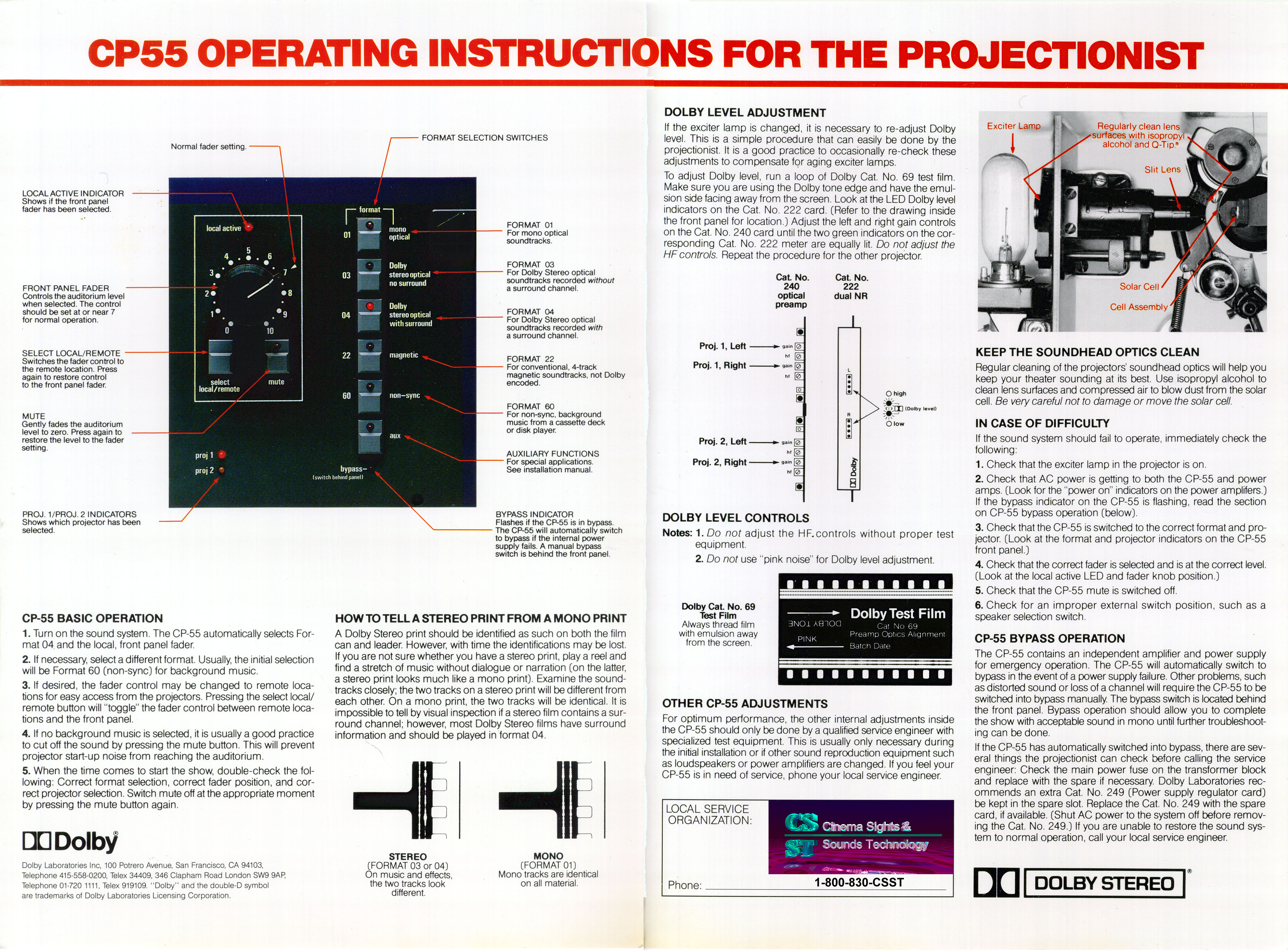
Dolby Laboratories has come up with some very successfull technologies for both professional and consumer equipment. Their most famous is Dolby Noise Reduction for films. Optical movie sound had been relatively unexciting and typically monophonic as it had a reputation for being noisey and of low fidelity. Dolby changed all of that with an encode-decode technology and new optical standards that brought optical film sound into the "high-fidelity" arena. Previous to Dolby, high-fidelity multichannel sound typically came from 70mm film with its magnetic tracks.
Magnetic may have had distinct advantages to optical in its reproduction capability. However, its disadvantages far outweighed the advantages. Magnetic film tracks wore out far too quickly, and the equipment was very costly to align and maintain. Magnetic also required more costly manufacturing processes to each an every print. The film had to be optically reproduced (picture), then oxide had to be coated on it for the sound tracks, and finally sound had to be recorded on to it.
Optical, on the other hand, is very low cost and can be part of the film reproduction process as it uses the film's optical characteristics to reproduce the sound.
Dolby found a way to compensate for optical noise with a multiband compression technique. Four different audio frequency bands had their dynamics compressed above the noise level at recording. When played back, the Dolby decoder restores the original dynamics by re-expanding them to their original levels. This has the added advantage of lowering the noise table to extremely quiet levels.
Along with Dolby Encoding, a new standard was set for the actual recording and "cell" playback devices. The advances in mechanical technology and bulb technology allowed the "slit" widths to be narrowed for stereo films and thus raise their reproduction capability to above FM Radio quality.
What brought Dolby Noise Reduction into the spotlight was the movie Star Wars by LucasFilm Ltd. and Twentieth Century Fox back in 1977. The impact Dolby gave to these films was extraordinary. Even the expensive 70mm prints of the movie used Dolby Noise reduction which made magnetic sound even better. However, 70mm only had the advantage of 6 channel sound over 4 channel optical.
Dolby has also made another technological breakthrough with its SR technology which expands the frequency response and signal to noise ratio even further for movies. It's called "Spectral Recording" and sounds magnificent.
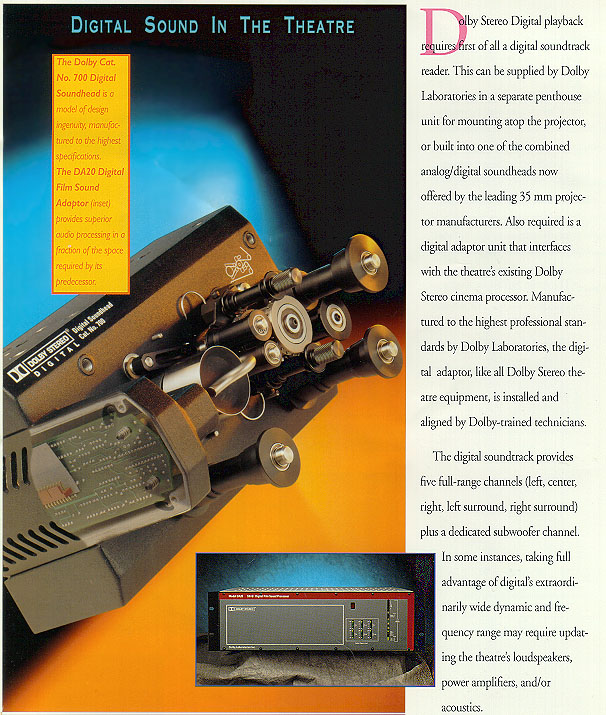
Dolby has joined the digtal reproduction arena with their 6 channel SR-D technology where digital sound is encoded right on the film.

Click on image for bigger picture
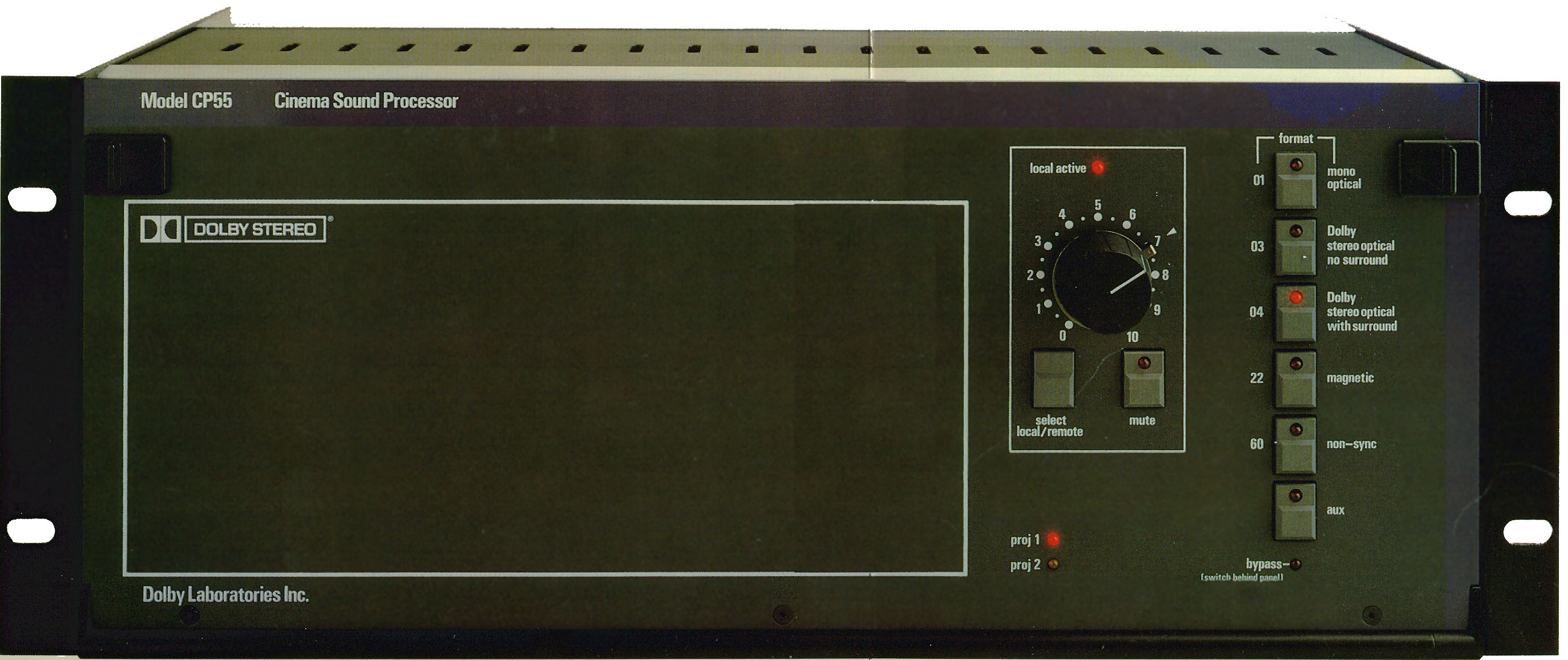 The CP55 Cinema processor. It is used in many
typical analog theaters. It has the capability of decoding Dolby with 4 channel
encoding in addidtion to subwoofer (if using the proper bass extension card). It has
separate multiband equalizers for the Left, Center, and Right channels, and has a
parametric equalizer for the surround and subwoofer channels. It also has support
for two projectors and background music. The CP55 Cinema processor. It is used in many
typical analog theaters. It has the capability of decoding Dolby with 4 channel
encoding in addidtion to subwoofer (if using the proper bass extension card). It has
separate multiband equalizers for the Left, Center, and Right channels, and has a
parametric equalizer for the surround and subwoofer channels. It also has support
for two projectors and background music. |
|
|
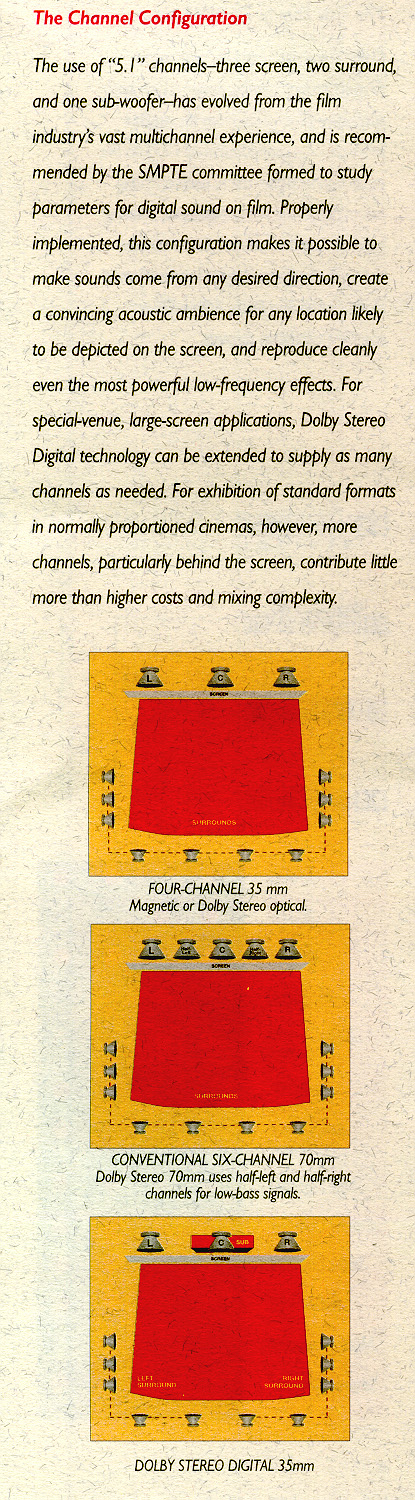 Dolby's own documented description of how their
digital equipment reproduces sound inside a theater. Dolby's own documented description of how their
digital equipment reproduces sound inside a theater. |
|
| CP500
Operating Manual The operating manual for the new CP500 cinema processor in Adobe Acrobat format. |
| CP65
Operating Manual The operating manual for the CP65 cinema processor in Adobe Acrobat format. |
| DA20
Operating Manual The operating manual for the DA20 SR-Digital cinema processor in Adobe Acrobat format. |